
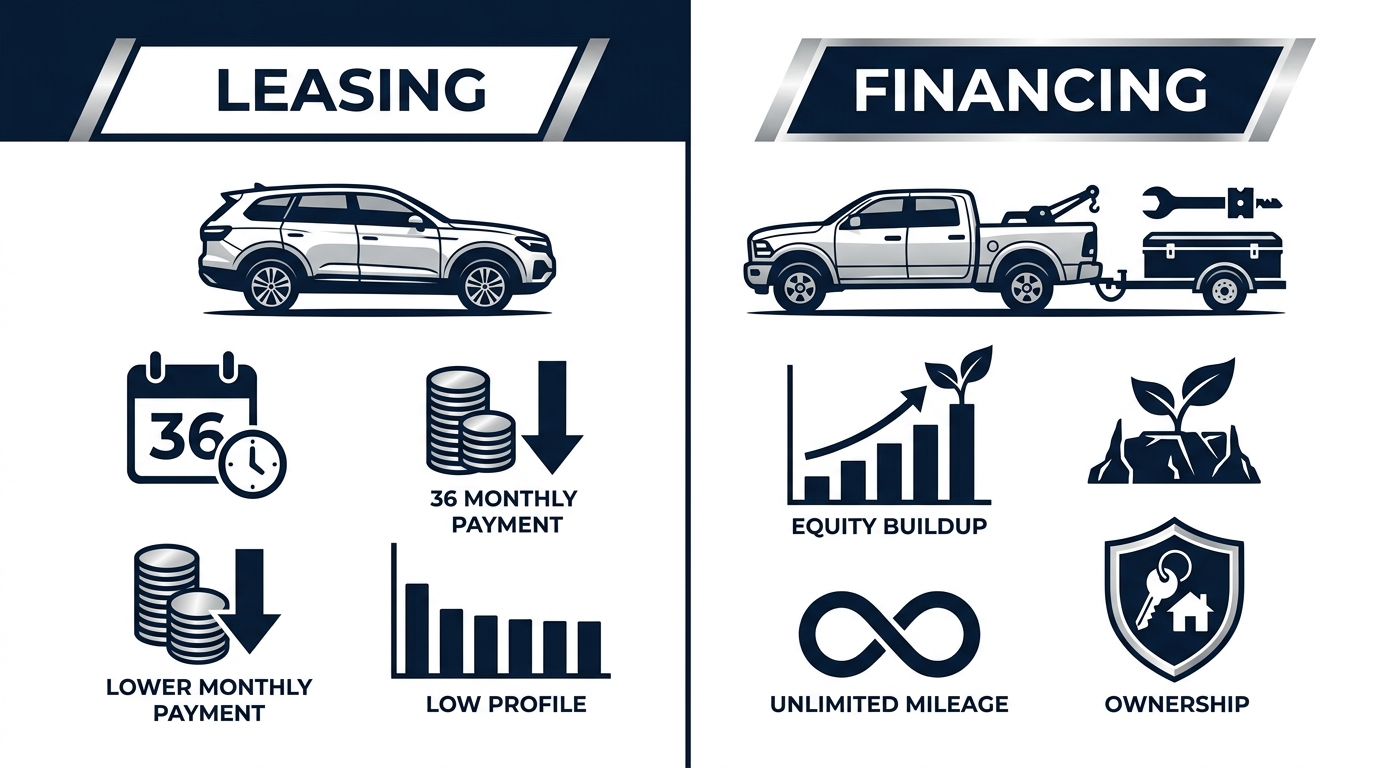
Choosing between leasing and financing a new Ford comes down to your personal driving habits, long-term ownership goals, and monthly payment preferences. A Ford Credit lease offers lower monthly payments, flexible 36-month terms, and built-in warranty protection for drivers who prefer upgrading every few years. Retail financing suits buyers planning long-term ownership without annual mileage limits, allowing you to build equity with competitive fixed interest rates.
When evaluating payment structures, matching the loan or lease terms to your household cash flow ensures a stress-free ownership experience. Standard lease agreements typically feature terms of 36 months with annual mileage allowances of 12,000 miles. Because a lease only covers the expected depreciation of the vehicle over the term rather than the full purchase price, monthly payments are noticeably lower than a conventional loan on the same trim. This makes leasing an attractive pathway if you want to drive a higher trim level with advanced technology and safety features while keeping fixed monthly overhead low.
Traditional retail financing, on the other hand, provides total freedom for high-mileage drivers and those who prefer to customize their vehicle. With loan terms usually spanning 36 to 72 months, purchasing a vehicle means every monthly payment contributes directly toward full vehicle ownership. Once the final installment is paid, you own the asset outright without ongoing vehicle payments. Furthermore, purchasing allows you to modify your truck or SUV with towing hitches, bed liners, or off-road packages without violating contract terms.
Our finance team at Paul Thigpen Ford of Waynesboro is dedicated to walking you through transparent payment comparisons for both options. If you want to review current pre-owned opportunities, you can explore pre-owned inventory options to compare pre-owned loan structures against new lease programs. You can also visit our Waynesboro showroom address or call our team directly at (706) 554-2114 to review personalized payment quotes tailored to your budget.
Table of Contents
- Should You Lease or Finance Your Next Ford in Waynesboro?
- What Documents Are Needed When Applying for Vehicle Financing?
- Which Ford SUV Is Best for Families Needing Three Rows?
- Which Ford Truck in the Lineup Is Best for Towing and Hauling?
- Quick Answers to Common Ford Financing and Leasing Questions
- Drive Home Your Next Ford from Paul Thigpen Ford
Should You Lease or Finance Your Next Ford in Waynesboro?
Leasing a Ford provides lower initial out-of-pocket costs, shorter ownership commitments, and continuous warranty coverage, making it ideal for predictable yearly mileage. Financing is the superior financial strategy if you log long annual commutes across rural Burke County, haul heavy equipment, or intend to keep your vehicle for many years after payoff.
Deciding between a lease and a finance agreement requires analyzing your typical driving routines around Waynesboro. Residents who commute daily along local agricultural roads or travel frequently for work often accumulate miles quickly. Standard lease contracts include annual limits, typically set at 10,000, 12,000, or 15,000 miles per year. Exceeding these thresholds results in excess mileage charges at lease turn-in, which means high-mileage drivers usually save money in the long run by choosing retail financing.
| Financial Factor | Ford Credit Lease | Retail Financing Loan |
|---|---|---|
| Primary Benefit | Lower monthly payments & newer vehicle technology | Total ownership equity & unlimited mileage |
| Term Length | Typically 24 to 36 months | Typically 36 to 72 months |
| Mileage Constraints | Set limits (10,000 to 15,000 miles/year) | No mileage restrictions |
| Repair Coverage | Covered by factory bumper-to-bumper warranty | Owner responsible after factory warranty expires |
| End-of-Term Options | Return vehicle, purchase at residual value, or trade | Clear title upon final payoff with no contract obligations |
Leasing offers clear advantages if your driving distance is predictable. Because most lease terms align with Ford's 3-year / 36,000-mile bumper-to-bumper factory warranty, major mechanical repairs are covered throughout the entire lease period. At contract end, you have the flexibility to return the vehicle, purchase it outright for the pre-determined residual value, or roll into a brand-new lease.
To start evaluating your purchasing power before visiting the dealership, you can take the first step by submitting an online credit application. If you want the balance of continuous warranty coverage alongside lower purchase prices, you can also browse certified pre-owned Ford models to see available late-model inventory.
What Documents Are Needed When Applying for Vehicle Financing?
Applying for vehicle financing through Ford Credit requires a valid driver's license, recent proof of income covering 30 consecutive days, proof of residence, and current auto insurance documentation. Bringing your existing vehicle's title and registration simplifies the transaction if you plan to use trade-in equity toward your purchase.
Organizing your documentation in advance speeds up the approval process and helps underwriters secure the best available interest rates. Lenders evaluate three core criteria when reviewing a finance application: borrowing capacity, credit reliability, and collateral value. Demonstrating stable monthly earnings reassures financial institutions that your proposed car payment fits comfortably within your debt-to-income ratio.
Gathering these specific items before visiting our showroom ensures a seamless experience:
- Personal Identification: A valid government-issued driver's license with your current physical address.
- Income Verification: Recent pay stubs spanning 30 days, recent W-2 forms, or bank statements showing consistent direct deposits.
- Proof of Residency: A recent utility bill or official lease agreement confirming your current living address.
- Vehicle Insurance: Current auto insurance card or policy declaration page listing active coverage details.
- Trade-In Paperwork: Vehicle title, current registration, and payoff documentation if an existing loan balance remains.
For service members and commuters driving into Augusta along regional highways, establishing clear income markers—including non-taxable housing allowances for military personnel—helps match your profile with specialized lender programs. Having these records organized allows our finance team to submit your file directly to national and regional lenders. You can view current new vehicle inventory to pick out your preferred model before arriving, or schedule a maintenance appointment online to have your current vehicle inspected prior to trading it in.
Which Ford SUV Is Best for Families Needing Three Rows?
The 2027 Ford Explorer is the primary three-row SUV in the lineup, offering comfortable seating for up to seven passengers and 16 cubic feet of rear cargo space. Powered by a standard 2.3-liter EcoBoost turbo I-4 engine generating 300 hp and providing a 5,000 lbs towing capacity, it delivers an optimal combination of cabin space, power, and safety technology.
Families comparing the Escape and Explorer on our lot usually look at third-row access before they check the window sticker. The second-row seats in the Explorer slide forward with a single button touch, making it effortless for children to climb into the third row. When maximum cargo space is required for family trips or sports gear, folding both rear rows flat expands total storage volume to 85 cubic feet.
2027 Ford Explorer Interior & Capability Specs:
• Seating Capacity: Up to 7 passengers (6 with available 2nd-row captain's chairs)
• Standard Engine: 2.3-liter EcoBoost turbo I-4 (300 hp / 310 lb-ft torque)
• Available Engine: 3.0-liter twin-turbo EcoBoost V6 (385 hp / 415 lb-ft torque)
• Standard Transmission: SelectShift® 10-speed automatic
• Cargo Volume Behind 3rd Row: 16 cubic feet
• Maximum Cargo Volume: 85 cubic feet (all rear seats folded)
• Maximum Towing Capacity: 5,000 lbs (with Class III Trailer Tow Package)
Modern family utility also requires intuitive cabin technology and active driver-assist safety systems. Every Explorer features the Ford Digital Experience infotainment software controlled via a 13.2-inch center touchscreen with integrated Google Maps and wireless Apple CarPlay connectivity. Standard Ford Co-Pilot360 safety features—including Pre-Collision Assist, Blind Spot Information System, and Lane-Keeping System—provide peace of mind on every family drive. Premium trims like the ST-Line and Platinum also offer available Blue Cruise for hands-free highway driving.
If you are choosing between a compact two-row crossover like the 2026 Escape and a full three-row SUV, evaluating your long-term passenger needs is key. The Escape delivers exceptional efficiency with available hybrid models reaching 42 mpg city / 36 mpg highway, but the Explorer remains the definitive choice when carrying more than five people is a daily requirement. You can prepare for your purchase today by estimating your trade-in value online.
Which Ford Truck in the Lineup Is Best for Towing and Hauling?
The 2027 Ford F-150 is the benchmark truck for towing and hauling, delivering a maximum conventional towing capacity of up to 13,500 pounds when properly equipped with the 3.5L EcoBoost V6 engine and Max Trailer Tow Package. Engineered with a high-strength, military-grade aluminum-alloy bed and a fully boxed steel frame, the F-150 handles demanding job sites and recreational towing with equal confidence.
Matching the right engine and cab configuration to your payload and towing demands ensures optimal performance. The F-150 lineup offers diverse engine options designed for distinct work requirements:
- 2.7L EcoBoost V6: Efficient performance with robust low-end torque for everyday towing.
- 5.0L V8: Traditional naturally aspirated power delivering a maximum payload rating of 2,455 pounds.
- 3.5L EcoBoost V6: High-output twin-turbo V6 producing 400 hp and 500 lb-ft of torque for maximum towing capability.
- 3.5L PowerBoost Full Hybrid V6: Combines twin-turbo power with an electric motor to generate 430 hp while returning an EPA-estimated 22 mpg city / 24 mpg highway.
Ford F-150 Capability Matrix by Engine:
┌─────────────────────────┬──────────┬───────────┬──────────────────────┐
│ Engine Option           │ Horsepower│ Torque    │ Key Advantage        │
├─────────────────────────┼──────────┼───────────┼──────────────────────┤
│ 2.7L EcoBoost V6        │ Unlisted │ Unlisted  │ Daily Efficiency     │
│ 5.0L V8                 │ 400 hp   │ 410 lb-ft │ Max Payload Capacity │
│ 3.5L EcoBoost V6        │ 400 hp   │ 500 lb-ft │ 13,500 lbs Max Tow   │
│ 3.5L PowerBoost Hybrid  │ 430 hp   │ 570 lb-ft │ Pro Power Onboard    │
└─────────────────────────┴──────────┴───────────┴──────────────────────┘
Beyond raw horsepower and towing specs, functional job-site technology sets the F-150 apart. Available Pro Power Onboard turns your truck into a mobile generator, offering power outlets in the bed ranging from 2.0 kW on standard gas engines up to 7.2 kW on hybrid models. This system easily runs power tools, air compressors, or camping gear directly from the vehicle. To keep your truck equipped for tough tasks, you can order genuine Ford parts and towing accessories directly through our specialized catalog.
Quick Answers to Common Ford Financing and Leasing Questions
Q: Can the dealership help me choose between a lease and a loan?
Leasing typically requires less upfront cash and offers lower monthly payments compared to financing, but ownership ends at lease term.
Q: What credit score is needed to qualify for Ford Credit lease offers?
While prime lease offers generally require credit scores of 660 or higher, Ford Credit provides flexible tier structures that allow buyers across varying credit profiles to qualify with appropriate income verification or a down payment.
Q: Should I lease a Ford Escape or a Ford Explorer?
Leasing a two-row Escape is ideal if you want lower monthly lease payments and high fuel economy, whereas leasing a three-row Explorer fits families needing seating for up to seven passengers and higher towing capacity.
Q: What is the maximum towing capacity of the Ford F-150 with the 3.5L EcoBoost V6?
When equipped with the 3.5L EcoBoost V6 engine and the optional Max Trailer Tow Package, the Ford F-150 achieves a class-leading maximum conventional towing capacity of up to 13,500 pounds.
Q: How does a trade-in affect my down payment on a new Ford lease or loan?
Applying trade-in equity directly reduces the net capital cost on a lease or the total financed principal on a loan, resulting in significantly lower monthly payments and reduced total finance charges.
Drive Home Your Next Ford from Paul Thigpen Ford
Finding the ideal vehicle payment structure is straightforward when working alongside dedicated professionals who value clarity, competitive terms, and straightforward advice. Whether you decide to lease a high-tech Explorer SUV or finance a dependable F-150 pickup, our team is committed to structuring a clear finance plan tailored to your budget.
We invite you to visit our dealership in person to test drive your preferred trim levels, review current Ford Credit lease offers, and evaluate your vehicle trade-in equity. Stop by our showroom located at 330 Highway 25 North, Waynesboro, GA 30830 or give us a call at (706) 554-2114 to get started today.