

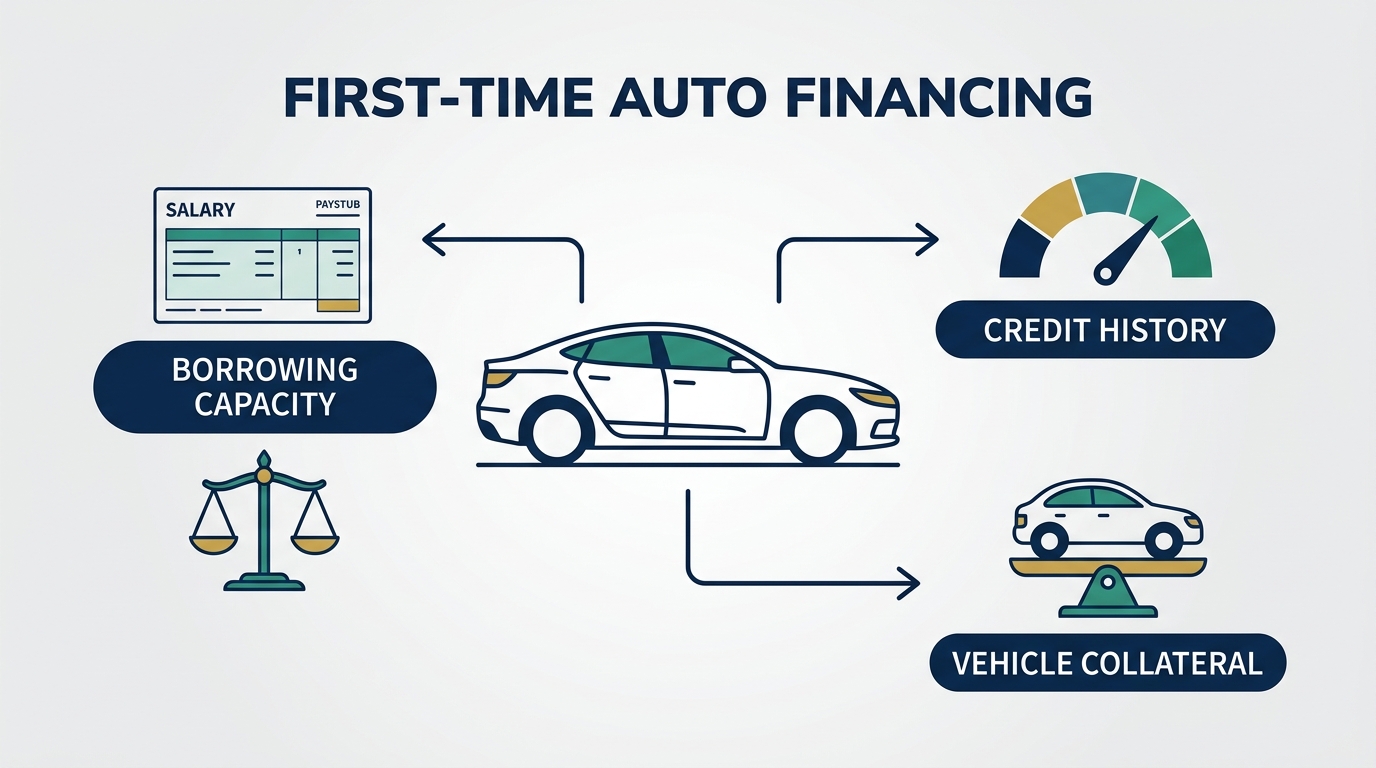
First-time auto financing works by matching a buyer's income, employment stability, and overall credit profile with a lender willing to issue a vehicle loan. Lenders evaluate your debt-to-income ratio and monthly earnings to establish loan amounts, interest rates, and required down payment thresholds. Securing pre-approval and establishing a clear monthly budget before shopping allows first-time buyers to set firm parameters, simplify negotiations, and compare loan terms with confidence.
Navigating your first auto purchase involves understanding how financial institutions assess borrowing risk. When reviewing an application, lenders analyze the three primary factors of credit history, borrowing capacity, and vehicle collateral. Capacity reviews your monthly take-home pay relative to existing debt obligations, while collateral evaluates the market value and age of the vehicle being financed. Credit history demonstrates your past payment reliability, though buyers with limited credit can still qualify by establishing strong income markers.
First-time shoppers visiting our showroom often ask what documents they need to prepare before testing out vehicles on the road. Bringing recent income documentation and personal identification speeds up the review process significantly. For drivers navigating rural commutes around Waynesboro for agricultural or local government work, establishing a manageable payment schedule ensures your vehicle stays reliable without straining your monthly household budget.
Starting your purchase journey with clear information prevents unexpected surprises at signing. You can take the first step toward vehicle ownership by submitting an online credit application to review potential loan options. If you have questions about current rates or lender guidelines, give our team a quick call at (706) 554-2114 or stop by our Waynesboro showroom to speak directly with our finance specialists.
Table of Contents
- What Income Proof, Credit History, and Co-Signer Rules Apply?
- How Do Military Auto Loans Work for Service Members at Fort Gordon?
- What Auto Loan Terms, APRs, and Down Payments Are Common?
- What Are the Advantages of Dealer Financing for First-Time Buyers?
- When Should First-Time Buyers Consider Refinancing to Lower Payments?
- Common Questions About First-Time Auto Financing
- Start Your First-Time Auto Financing Process Today
What Income Proof, Credit History, and Co-Signer Rules Apply?
Auto lenders require first-time buyers to provide 30 consecutive days of recent pay stubs, W-2 statements, or electronic bank records showing consistent direct deposits to verify steady income. While a FICO score of 660 or higher helps secure prime financing rates, buyers with credit scores in the 580 to 650 range or thin credit files can still earn loan approval by presenting stable income or adding a qualified co-signer.
Documenting stable employment is essential for buyers who lack an established credit track record. Lenders typically look for at least six months of continuous employment with your current employer, or two years within the same line of work. If your credit score falls below the mid-600s, lenders may adjust interest rates upward or ask for additional documentation to offset risk, making thorough preparation vital before submitting your file.
- Income Verification: Provide recent pay stubs covering a full 30-day period or complete W-2 forms showing regular earnings.
- Proof of Residence: Supply a recent utility bill or official lease agreement matching the address on your application.
- Co-Signer Eligibility: Select a co-signer who possesses established prime credit and sufficient income to cover the loan if necessary.
In Georgia, utilizing a co-signer is a practical way for first-time buyers to qualify for lower interest rates and higher loan approvals. A co-signer legally commits to assuming financial responsibility for the loan balance if payments are missed. Because the lender evaluates the co-signer's established credit profile alongside your income, adding a parent or family member often opens access to flexible terms while helping you build your personal credit score. First-time buyers can also lower their total loan requirements by exploring our pre-owned vehicle lineup for budget-friendly transportation options.
How Do Military Auto Loans Work for Service Members at Fort Gordon?
Military auto loans provide active-duty service members and veterans specialized financing benefits, including flexible down payment requirements, competitive interest rates, and protections mandated by federal law. The Military Lending Act safeguards military personnel by capping covered interest rates and fees, ensuring transparent loan terms and manageable monthly obligations.
Service members transitioning into a new vehicle benefit from finance terms structured around military pay schedules. Lenders experienced in military financing factor in non-taxable allowances—such as Basic Allowance for Housing and Basic Allowance for Subsistence—when calculating your debt-to-income ratio. This specialized underwriting approach gives military personnel stationed in Augusta greater borrowing flexibility when purchasing a dependable vehicle for daily commutes or duty assignments.
Specialized military financing programs also accommodate deployment schedules and sudden relocation orders. Many military-focused lenders offer deferred initial payment options or specialized lease and loan provisions that adjust during overseas assignments. Buyers can further reduce their total loan obligation before finalizing military auto financing by appraising your trade-in online to convert existing vehicle equity into an immediate down payment.
What Auto Loan Terms, APRs, and Down Payments Are Common?
Common auto loan terms for new vehicles span 36 to 72 months with fixed annual percentage rates tied directly to applicant credit scores, while pre-owned vehicles usually carry slightly shorter maximum terms. Providing a down payment of 10% to 20% lowers the initial principal balance, reduces total interest charges, and improves financing approval odds across all credit tiers.
Selecting the right loan length involves balancing your target monthly payment against long-term interest expenses. While extending a loan term to 72 or 84 months decreases the required monthly payment, it increases total finance charges paid over the life of the agreement. Keeping terms between 48 and 60 months keeps overall borrowing costs significantly lower while maintaining a steady equity schedule in your vehicle.
| Loan Term Length | Impact on Monthly Payment | Total Interest Cost | Recommended Credit Profile |
|---|---|---|---|
| 36 to 48 Months | Higher Monthly Payment | Lowest Overall Finance Cost | Established Prime Credit |
| 60 Months | Balanced Monthly Payment | Moderate Overall Finance Cost | First-Time & Standard Buyers |
| 72 to 84 Months | Lower Monthly Payment | Highest Overall Finance Cost | Budget-Conscious Buyers |
Financial experts recommend keeping total monthly vehicle costs—including principal, interest, auto insurance, and fuel—at or below 10% to 15% of your monthly net take-home pay. Preparing a 10% to 20% down payment reduces financial risk for the lender, which frequently results in more favorable APR offers and eliminates the need for expensive gap insurance policies.
What Are the Advantages of Dealer Financing for First-Time Buyers?
Dealer financing offers first-time buyers access to a network of national banks, regional credit unions, and manufacturer-backed finance institutions through a single application process. This broad access creates a competitive environment where lenders compete for your loan contract, increasing approval opportunities for applicants with limited or developing credit histories.
Working directly with a dealership finance department streamlines vehicle selection, credit evaluation, and paperwork into a single visit. Rather than securing a standalone loan through a single bank, dealer finance teams compare multiple lender offers simultaneously to secure favorable APRs and flexible loan durations tailored to your budget.
- Broad Lender Networks: Access national banks, local credit unions, and specialized first-time buyer finance programs simultaneously.
- Manufacturer Incentives: Qualify for factory finance offers, interest rate discounts, and regional buyer incentives.
- Simplified Purchasing: Combine vehicle test drives, trade-in valuations, credit approval, and contract signing in one place.
Captive lenders associated directly with vehicle manufacturers frequently run promotional financing deals that traditional banks cannot match. These specialized finance programs often feature lower APR offers or flexible approval parameters designed specifically to assist buyers purchasing their first vehicle. You can explore available models and current manufacturer offers by shopping our latest new Ford inventory today.
When Should First-Time Buyers Consider Refinancing to Lower Payments?
First-time buyers should consider refinancing an auto loan after establishing 6 to 12 months of consistent, on-time payment history or when market interest rates decrease noticeably. Reducing an interest rate by 2% to 4% through refinancing can lower monthly car payments by $30 to $75 while saving hundreds of dollars in total interest over the remaining loan balance.
Refinancing makes sense when your personal credit profile improves significantly after taking on your initial car loan. Making full, on-time payments every month builds positive credit momentum, raising your FICO score and qualifying you for prime interest rates that were unavailable during your initial purchase.
Before completing a refinancing agreement, verify that your current auto loan carries no early payoff penalties and that your vehicle's current market value exceeds the remaining loan balance. Refinancing into a shorter term at a lower APR maximizes long-term savings, allowing you to pay off the vehicle faster while reducing total finance fees.
Common Questions About First-Time Auto Financing
Q: How much of my monthly income should go toward a car loan payment?
Keeping total monthly vehicle expenses—including your loan payment, auto insurance, fuel, and basic care—at or below 10% to 15% of your net take-home pay ensures a comfortable balance. Calculating expenses against your actual take-home pay rather than gross earnings protects your monthly cash flow for housing, savings, and general living costs.
Q: Can I qualify for an auto loan if I have no credit score?
Yes, first-time buyers without an established credit history can secure auto financing through specialized lender programs. Financial institutions evaluate job longevity, monthly income consistency, and debt-to-income balance in place of a credit score. Supplying complete proof of employment or adding a co-signer with good credit increases your loan approval odds significantly.
Q: What key fees should I compare when reviewing auto loan offers?
When comparing auto loan quotes, examine the overall annual percentage rate, documentation charges, lender origination fees, and total interest expenses over the full loan term. Reviewing the total finance charge rather than focusing solely on the monthly payment figure reveals the true cost of each financing offer.
Q: Does applying for pre-qualification affect my credit score?
Pre-qualifying for an auto loan requires a soft credit inquiry, which allows lenders to estimate potential loan amounts and interest rates without impacting your credit score. Once you select a vehicle and complete a formal credit application, the lender performs a hard inquiry to finalize your loan approval terms.
Q: Is it easier for a first-time buyer to finance a pre-owned vehicle?
Pre-owned vehicles typically carry lower purchase prices, which reduces the overall loan amount needed and makes initial income qualification easier for budget-focused buyers. However, new vehicles often qualify for lower APR rates through manufacturer financing, making it beneficial to compare overall loan costs for both options.
Start Your First-Time Auto Financing Process Today
Establishing your first auto loan is a straightforward process when guided by experienced finance professionals who prioritize clear terms and manageable payments. Securing pre-approval, organizing your proof of income, and choosing a vehicle that matches your lifestyle parameters ensures a rewarding ownership experience from day one.
Our finance team is ready to walk you through every step of the approval process, answer your questions, and structure an auto loan that fits your budget perfectly. Connect with our specialists by making a quick call to (706) 554-2114 or stop by visit our dealership location to explore our complete vehicle inventory and finalize your financing today.
Keep Your Vehicle Running Strong
Keep your vehicle performing at its best with our service team: