

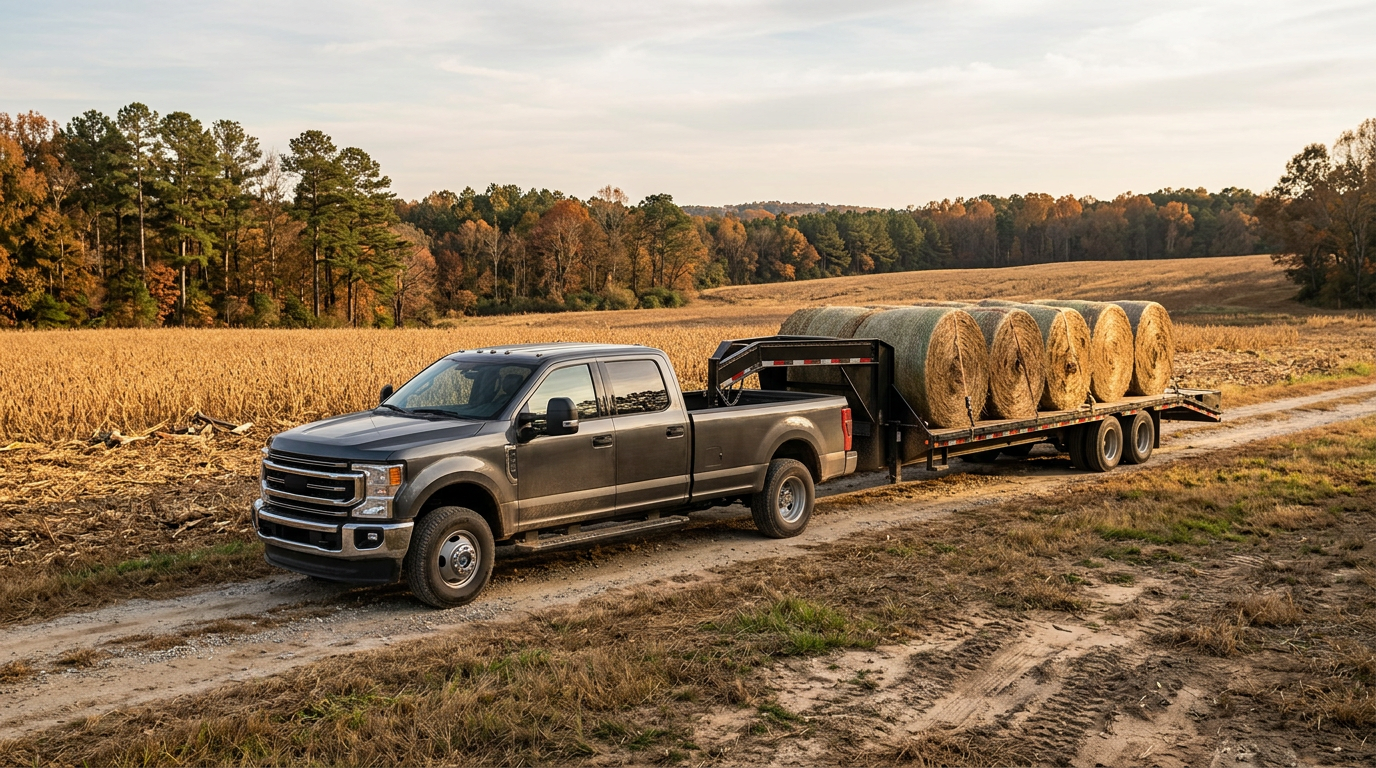
Preparing Your Ford F-Series for Harvest Towing: A GM's Guide to Payload, Braking, and Field Setup
How Do Payload Limits and Towing Capacities Differ Between the Ford F-150 and F-250 Super Duty?
The 2026 Ford F-150 offers a maximum available payload of 2,440 lb and a maximum conventional towing capacity of 13,500 lb when properly configured. In contrast, the 2026 Ford F-250 Super Duty increases payload capacity up to 4,260 lb and conventional towing up to 22,000 lb, with gooseneck towing reaching 23,000 lb. This structural jump stems from the Super Duty’s heavier commercial frame, thicker axle shafts, and higher gross vehicle weight ratings.
When farmers evaluate payload, they are measuring how much weight the truck frame, rear springs, and bed can carry directly over the axles. On the half-ton platform, reaching the peak 2,440 lb payload requires an XLT SuperCrew 4x4 or XL model equipped with a 6.5-foot box, the 3.5L EcoBoost V6, and the specialized payload package. Lower trims with smaller engines, like the standard 2.7L EcoBoost V6, top out at 1,775 lb of payload and 8,400 lb of towing, while the 5.0L V8 delivers 2,235 lb of payload and 12,800 lb of towing capacity. The 3.5L PowerBoost hybrid offers up to 1,740 lb of payload alongside 11,600 lb of towing capacity.
Stepping up to the heavy-duty lineup changes the mechanical baseline entirely. The 2026 Ford F-250 Super Duty utilizes a high-strength, fully boxed steel frame built for heavy pin weights and tongue loads. While a gas-powered 7.3L V8 Super Duty provides maximum bed payload up to 4,260 lb, choosing the high-output 6.7L PowerStroke V8 diesel engine reduces maximum bed payload slightly to 3,807 lb due to the heavier engine block, while boosting low-end torque to 1,200 lb-ft. For local operators hauling high-density grain or heavy equipment across Burke County around Waynesboro, understanding these bed limits prevents dangerous rear axle overload before hitting field roads. If you want to review specific door-jamb weight ratings in person, stopping by our showroom on Highway 25 or giving our team a quick call at (706) 554-2114 gives you exact figures for every truck layout.
Table of Contents
- Is a Ford F-150 Sufficient for Agricultural Harvest Equipment or Do You Need an F-250?
- What Pre-Season Vehicle Maintenance Keeps Your Ford F-Series Ready for Harvest Towing?
- How Do You Test and Calibrate the Integrated Trailer Brake Controller on a Ford Truck?
- How Does Ford Smart Hitch Help Balance Trailer Tongue Weight During Harvest?
- Which Rear Axle Ratio Is Ideal for Heavy Agricultural Towing on Ford Super Duty Trucks?
- What Safety Chain and Breakaway Switch Checks Are Essential Before Towing Harvest Loads?
Is a Ford F-150 Sufficient for Agricultural Harvest Equipment or Do You Need an F-250?
A 2026 Ford F-150 equipped with the 3.5L EcoBoost V6 and Tow/Haul Package is fully capable of pulling lighter agricultural harvest equipment such as single-axle seed tenders, utility flatbeds, and liquid fertilizer wagons weighing under 10,000 lb. However, pulling loaded multi-ton grain carts, high-capacity gravity wagons, or multi-horse gooseneck trailers requires a Ford F-250 Super Duty or F-350 Super Duty to safely manage heavy tongue weights and unpaved field traction.
The primary distinction between half-ton and heavy-duty field performance comes down to stability under variable load conditions. Agricultural trailers often lack internal baffles or possess shifting centers of gravity that transfer dynamic forces straight to the hitch receiver. The 2026 Ford F-150 manages these loads cleanly when configured with the Tow/Haul Package, which includes an integrated trailer brake controller and a 3.55 electronic-locking rear axle or 3.73 electronic-locking rear axle to secure rear-wheel traction in damp soil.
When harvest demands exceeding 12,000 lb of continuous trailer weight enter the picture, the heavier curb weight of the Super Duty chassis becomes essential. An F-250 Super Duty weighs significantly more than an F-150, preventing heavy agricultural equipment from pushing the tow vehicle on steep grades or wet clay transitions. For farms balancing daily farm chores with seasonal transport, checking out our pre-owned truck inventory offers access to heavy-duty platforms equipped with heavy-capacity axles and factory fifth-wheel prep packages.
What Pre-Season Vehicle Maintenance Keeps Your Ford F-Series Ready for Harvest Towing?
Pre-season harvest towing maintenance requires inspecting engine cooling systems, testing transmission fluid quality, verifying brake friction material thickness, inspecting 7-pin electrical connections, and setting tire inflation to the maximum cold rating printed on the driver-side door jamb placard. Adjusting tire pressures up to 50 PSI or higher on LT metric load range E tires ensures full load capability and reduces sidewall flex under load.
High ambient temperatures combined with slow field maneuvering put immense thermal strain on truck powertrains. Inspecting the radiator and transmission cooler for chaff, dust, and field debris prevents overheating when pulling heavy wagons down dirt lanes. Transmission fluid breaks down rapidly under high heat, so flushing aged fluid before the harvest push safeguards internal clutch packs in the 10-speed automatic transmission.
Brake maintenance goes beyond checking front and rear pads on the truck itself. Inspecting the wiring harness and clean grounds on the 7-pin connector ensures smooth electrical signals reach the trailer brakes. For operators moving grain between field loading points around Hephzibah and regional collection points, verifying suspension components, leaf spring bushings, and shock absorbers prevents premature tire wear. Drivers planning their seasonal equipment upgrades can explore our new Ford truck selection or look through certified pre-owned Ford models to find trucks pre-equipped with high-capacity cooling packages.
How Do You Test and Calibrate the Integrated Trailer Brake Controller on a Ford Truck?
Calibrate the integrated trailer brake controller by driving the truck and trailer at 20 mph on a level, paved road, manually squeezing the brake controller slider without pressing the vehicle brake pedal, and adjusting the gain setting until the trailer brakes slow the combination firmly without locking the trailer tires.
Proper gain calibration prevents trailer push during sudden stops and stops the trailer from pulling heavily on the truck frame during routine slowdowns. If the trailer tires lock up and drag during manual activation, lower the gain setting by half-point increments using the steering wheel controls or dash slider. If the truck feels like it is doing all the stopping work, increase the gain until response feels instantaneous and synchronized.
Different trailer types require different brake effort settings within the SYNC 4 touchscreen menu. Selecting between low, medium, or high initial brake effort tailors the electrical output curve to match electric-over-hydraulic or standard electric trailer brakes. When setting up complex agricultural equipment, booking a service appointment with our factory-trained technicians ensures your trailer brake module is updated with the latest software calibrations. Drivers considering upgrading their current truck prior to peak harvest season can start by valuing their trade-in online.
How Does Ford Smart Hitch Help Balance Trailer Tongue Weight During Harvest?
Ford Smart Hitch measures trailer tongue weight directly using integrated height sensors in the suspension, displaying real-time weight calculations on the 12-inch SYNC 4 center touchscreen or Ford App mobile app to guide proper cargo positioning. The system indicates whether weight must be moved forward or backward to achieve the target 10 to 15 percent tongue weight ratio required for safe towing.
Uneven weight distribution is a leading cause of trailer sway and light front-axle steering on farm roads. When loading grain bags, seed totes, or equipment onto a trailer, Smart Hitch eliminates manual weight guesswork by showing a dynamic visual bar graph on the screen that fills up as weight is applied to the ball mount. If the bar enters the red zone, the system alerts the driver that excessive tongue weight is overloading the rear suspension.
When local farmers ask me how to simplify pre-trip checks during busy harvest weeks, I show them how Smart Hitch allows one person to load a seed tender in the yard and confirm proper weight distribution before ever putting the truck in drive. This onboard intelligence pairs seamlessly with Pro Trailer Backup Assist, letting drivers maneuver trailers into tight barn bays with precision. Buyers building a custom work truck can start by submitting a pre-approval financing application to secure equipment before harvest starts.
Which Rear Axle Ratio Is Ideal for Heavy Agricultural Towing on Ford Super Duty Trucks?
A 3.73 electronic-locking rear axle or 4.10 rear axle ratio is ideal for heavy agricultural towing on Ford Super Duty trucks because it provides the numerical gear reduction required to launch heavy loads on soft unpaved field surfaces without slipping transmission clutches or stalling engine momentum.
Rear axle ratios determine how many times the driveshaft rotates for every single rotation of the rear wheels. A higher numerical ratio like 4.10 delivers maximum mechanical advantage at low vehicle speeds, making it easier to pull a fully loaded grain wagon out of muddy field entry points. For trucks that split time between field pulling and highway transit, a 3.73 electronic-locking rear axle offers a strong compromise between low-end crawling force and efficient highway cruising RPM.
Electronic-locking differentials provide an additional layer of field traction by mechanically locking both rear axle shafts together at the touch of a button. This prevents a single wheel from spinning uselessly in loose dirt or damp grass when pulling heavy harvest equipment. If you need replacement differential fluid, heavy-duty hitch receivers, or trailer wiring accessories, ordering genuine Ford parts through our department guarantees factory-fit reliability.
What Safety Chain and Breakaway Switch Checks Are Essential Before Towing Harvest Loads?
Essential pre-towing safety checks require crossing heavy-duty safety chains beneath the trailer tongue to form a protective cradle, verifying chains have zero ground drag, and attaching the emergency breakaway switch cable directly to an unyielding frame point on the truck while confirming the trailer’s onboard breakaway battery is fully charged.
Crossing safety chains beneath the coupler ensures that if the trailer ball or hitch mechanism disconnects, the trailer tongue drops onto the crossed chains rather than digging into the road surface. Chains must retain sufficient slack to allow full turning radius maneuvering without binding, but remain high enough off the ground to prevent dragging over field ruts or asphalt edges.
The emergency breakaway switch acts as the final safety line if a trailer completely detaches from the tow vehicle. Fastening the breakaway cable to the truck frame—never to the removable hitch ball or safety chain hooks—ensures the cable pulls the internal switch pin if separation occurs, immediately engaging the trailer’s electric brakes via its onboard battery. Before pulling heavy harvest loads on public highways, drivers can get detailed safety inspections by finding our dealership on Highway 25 or calling our service team directly at (706) 554-2114.
© 2026 Paul Thigpen Ford of Waynesboro. All rights reserved.