
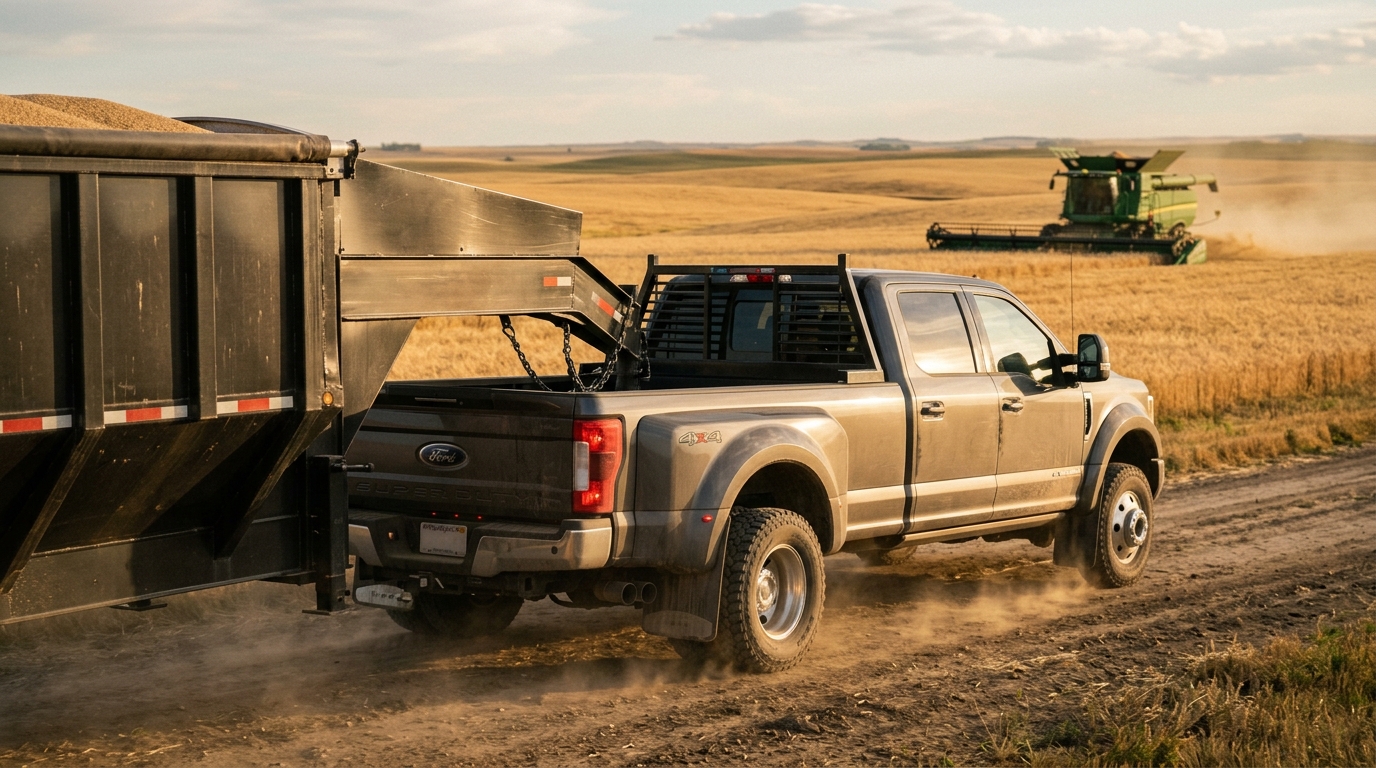
The Ford F-350 dual-rear-wheel configuration powered by the 6.7L High Output Power Stroke V8 Turbo Diesel engine is the overall best Ford Super Duty model for heavy agricultural harvest towing. It balances a maximum available gooseneck towing capacity of 40,000 lbs with a maximum payload rating of 8,000 lbs, providing the structural stability needed for heavy grain trailers, livestock equipment, and bulk seed hauling.
Selecting the right heavy-duty truck for harvest demands matching gross vehicle weight ratings ( GVWR) and gross combined weight ratings ( GCWR) to your specific trailering requirements. While single-rear-wheel F-250 models excel at daily farm transportation and bumper-pull utility hauling with payloads in the 4,200 lbs range, dual-rear-wheel F-350 and F-450 trucks deliver the rear-axle stability needed when hitching heavy gooseneck grain wagons. For conventional bumper-pull equipment, properly equipped Super Duty models support up to 30,000 lbs of towing capacity, while fifth-wheel hitches handle up to 35,000 lbs.
Navigating the gently rolling farmland and mixed agricultural routes surrounding Waynesboro requires a chassis engineered for continuous high-load strain. Ford equips these trucks with fully boxed high-strength steel frames, heavy-duty rear axles, and commercial-grade braking systems designed to stop heavily loaded agricultural trailers safely. Whether moving harvesting machinery between fields or pulling loaded trailers to regional grain elevators, matching axle ratios and suspension packages to payload targets prevents component wear and maintains highway safety.
Our commercial specialists assist local farm managers in evaluating trim levels ranging from functional XL and XLT work trucks to option-packed Lariat, King Ranch, and Platinum editions. Stopping by our Waynesboro dealership location allows you to compare chassis layouts in person, or you can give our commercial sales team a call at (706) 554-2114 to discuss custom upfits and trailering specifications.
Table of Contents
- Is the Diesel Worth It for Farm Towing and What Engine Delivers Maximum Capacity?
- What Hardware Packages, Gooseneck Hitches, and Onboard Scales Are Required for Farm Trailers?
- Which Ford Truck Offers the Best Turning Radius for Maneuvering Grain Wagons in Tight Yards?
- How Does Section 179 Tax Deduction Apply to Heavy Farm Trucks Like the F-250 and F-350?
- What Maintenance, Engine Oil, and Trailer Safety Inspection Rules Apply During Georgia Harvest?
- Frequently Asked Questions About Heavy-Duty Ford Farm Trucks in Waynesboro
Is the Diesel Worth It for Farm Towing and What Engine Delivers Maximum Capacity?
For farm operations towing heavy gooseneck trailers exceeding 15,000 lbs, the 6.7L High Output Power Stroke V8 Turbo Diesel engine delivers unmatched 500 hp and 1,200 lb-ft torque, making it a top choice. This massive low-end torque allows heavy grain wagons and livestock trailers to accelerate smoothly from field stops without overworking the powertrain.
When local farm operators evaluate engine options on our lot, they usually compare the lower up-front cost of gas against the long-distance pulling power of diesel before deciding on their harvest rig. Gas engines like the standard 6.8L V8 and the available 7.3L Devictus V8 offer exceptional reliability and lower initial purchase costs for light-to-medium farm duties. However, the standard 6.7L Power Stroke V8 Turbo Diesel ( 475 hp and 1,050 lb-ft of torque) and the High Output variant are essential for reaching maximum gooseneck tow ratings up to 40,000 lbs.
Every Super Duty engine couples with a heavy-duty TorqShift 10-speed automatic transmission featuring selectable drive modes. Modes such as Tow/Haul recalibrate shift points to keep the engine in its optimal power band while engaging automatic engine braking during downhill descents. This feature preserves service brakes when descending steep grade roads with heavy agricultural loads.
Evaluating annual engine hours, trailer weight thresholds, and seasonal mileage helps determine whether gas or diesel provides the best return on investment for your agricultural fleet. Exploring our new Ford Super Duty selection gives you access to both gas and diesel powertrain configurations configured for immediate farm deployment.
What Hardware Packages, Gooseneck Hitches, and Onboard Scales Are Required for Farm Trailers?
Achieving maximum gooseneck or fifth-wheel towing capacity on a Ford Super Duty requires factory-installed hardware packages, specifically the Gooseneck / 5th-Wheel Hitch Prep Package (Option Code 53W). This factory package integrates five pickup bed attachment points flush into the bed floor along with a 7-pin trailer wiring harness built directly into the rear bed wall.
To safely handle maximum agricultural payload limits up to 8,000 lbs, specific models also require the High-Capacity Axle Package or Heavy-Duty Payload Package. These options supply upgraded rear axle shafts, high-capacity leaf springs, and enhanced thermal cooling components designed to protect the driveline during continuous summer towing. Operating without these factory prep packages severely limits permissible tongue weight and violates gross vehicle weight limits.
Ford integrates advanced payload monitoring directly into the truck through Onboard Scales with Smart Hitch technology. This system measures payload weight in real time and calculates tongue weight distribution when coupling gooseneck or conventional trailers. Drivers can view real-time weight status on the central 12-inch SYNC 4 touchscreen, monitor estimates on a mobile smartphone app, or observe visual LED load indicators built directly into the truck's taillamps.
Monitoring real-time payload ensures grain hoppers and equipment trailers do not exceed vehicle ratings before hitting public roads. Reviewing our pre-owned heavy-duty truck inventory provides cost-effective access to equipped work trucks carrying these essential factory towing packages.
Which Ford Truck Offers the Best Turning Radius for Maneuvering Grain Wagons in Tight Yards?
The Ford F-450 Super Duty and select F-350 DRW models equipped with the wide-track front axle option deliver the sharpest turning radius in the heavy-duty truck class. The wider front axle housing permits front wheels to steer up to 45 degrees, creating a turning circle significantly tighter than standard 3/4-ton pickups like the Ram 2500 or Chevrolet Silverado 2500 HD.
Maneuvering long grain wagons, seed tenders, and wide machinery through tight farm yards, narrow barn alleyways, and gate openings requires maximum front-end articulation. The wide-track front suspension design reduces the need for multi-point turns when backing heavy trailers toward grain augers or maneuver-restricted loading docks. This steering geometry eases stress on front ball joints and power steering pumps when turning fully loaded rigs on high-friction gravel surfaces.
Complementing this physical turning maneuverability is Ford's available 360-Degree Camera Package and Pro Trailer Backup Assist. Using a center console knob, drivers control trailer direction while the truck manages steering inputs, making complex backing maneuvers around farm structures predictable and accurate.
Drivers navigating tight farmyard footprints benefit from testing front-axle steer angles during physical walkarounds. Checking certified pre-owned Ford truck inventory allows farm managers to find wide-track equipped heavy-duty models protected by factory warranty coverage.
How Does Section 179 Tax Deduction Apply to Heavy Farm Trucks Like the F-250 and F-350?
Under Section 179 of the Internal Revenue Code, qualifying agricultural businesses can deduct up to 100% of the purchase price of eligible heavy-duty farm trucks acquired and placed in service during the current tax year. Because Ford Super Duty models feature a Gross Vehicle Weight Rating ( GVWR) exceeding 6,000 lbs, they qualify as heavy commercial vehicles for accelerated tax depreciation.
To qualify for full Section 179 tax treatment, the truck must be used more than 50% for business or agricultural operations. Heavy-duty pickup trucks with cargo bed lengths of six feet or longer, as well as chassis cab models equipped with flatbeds, utility bodies, or dump beds, offer optimal tax flexibility for farm accounting. Tax write-offs lower overall vehicle acquisition costs, directly benefiting seasonal farm operating margins.
Agricultural fleet managers often combine Section 179 write-offs with bonus depreciation rules to offset federal income tax liabilities during profitable harvest years. Consulting with a certified public accountant or agricultural tax advisor ensures equipment purchases align with current tax law provisions and corporate filing schedules.
Planning equipment purchases around harvest income allows farm operators to upgrade fleet capability while managing cash flow. Drivers preparing to upgrade can value your trade-in online to establish clear trade equity figures before completing a commercial vehicle purchase.
What Maintenance, Engine Oil, and Trailer Safety Inspection Rules Apply During Georgia Harvest?
Operating heavy-duty diesel trucks in continuous summer heat while towing maximum loads requires heavy-duty 15W-40 engine oil meeting API CK-4 or CJ-4 specifications. For severe-duty agricultural towing under high ambient temperatures, using 5W-40 full synthetic engine oil ensures thermal stability, prevents oil breakdown, and maintains critical oil pressure during prolonged idling at harvest drop points.
Farm operations managing agricultural acreage around Hephzibah rely on rigorous preventive maintenance schedules to prevent costly downtime during peak crop harvesting windows. Engine air filters must be inspected frequently due to heavy field dust, while transmission fluid and rear differential lubricants require strict adherence to severe-duty service intervals.
Georgia highway regulations enforce strict safety inspection items for farm trailers operated on public roads. Legally compliant farm trailers must feature:
- Fully operational brake lights, tail lamps, and turn signals connected via functional wiring harnesses.
- Operational breakaway brake systems equipped with emergency battery power for trailers exceeding 3,000 lbs gross weight.
- Properly rated safety chains crossed under the trailer tongue and securely latched to the hitch receiver.
- Clean retroreflective tape and slow-moving vehicle ( SMV) emblems clearly visible from trailing distances.
- Commercial-grade tires displaying adequate tread depth without sidewall cracking or structural dry rot.
Keeping commercial fleets compliant and operational requires access to dedicated technical support. You can schedule a service appointment online with our certified diesel technicians, or prepare your budget by submitting a finance application ahead of your next vehicle service visit.
Frequently Asked Questions About Heavy-Duty Ford Farm Trucks in Waynesboro
Q: What is the maximum gooseneck towing capacity of the Ford Super Duty? When properly equipped, the 2026 Ford Super Duty F-450 powered by the 6.7L High Output Power Stroke V8 Turbo Diesel engine achieves a best-in-class maximum gooseneck towing rating of up to 40,000 lbs. Single-rear-wheel F-250 and F-350 configurations offer gooseneck ratings tailored for medium-duty agricultural trailers up to 22,000 lbs and 35,000 lbs respectively.
Q: Do I need a special hitch package to tow a gooseneck trailer with an F-250 or F-350? Yes, factory gooseneck towing requires the Gooseneck / 5th-Wheel Hitch Prep Package (Option Code 53W). This package equips the truck bed with integrated structural crossmembers, five drop-in mounting holes, and a bed-mounted 7-pin electrical connector. You can easily order genuine Ford parts online or drop-in hitch ball kits through our dealership parts counter.
Q: How do Onboard Scales help prevent overloading during harvest? Ford's Onboard Scales use suspension sensors to calculate payload weight in real time as cargo or trailer weight is loaded into the truck. The weight calculation displays visually on the 12-inch SYNC 4 interior screen, through the Ford App smartphone application, or via integrated LED light bars built into the taillamps that illuminate step-by-step as you approach maximum payload capacity.
Q: Why is engine oil choice critical for diesel towing in summer heat? Towing heavy agricultural loads in high heat causes elevated engine and turbocharger oil temperatures. Using API CK-4 rated 15W-40 or 5W-40 full synthetic heavy-duty motor oil prevents thermal oxidation, protects internal bearings under extreme pressures, and maintains proper viscosity during sustained high-load highway pulling.
Q: How can I schedule commercial service or test drive a Super Duty truck? You can visit our Waynesboro showroom to speak directly with our commercial vehicle team, or contact our department by phone at (706) 554-2114 to review inventory, arrange fleet maintenance, or set up a test drive.