

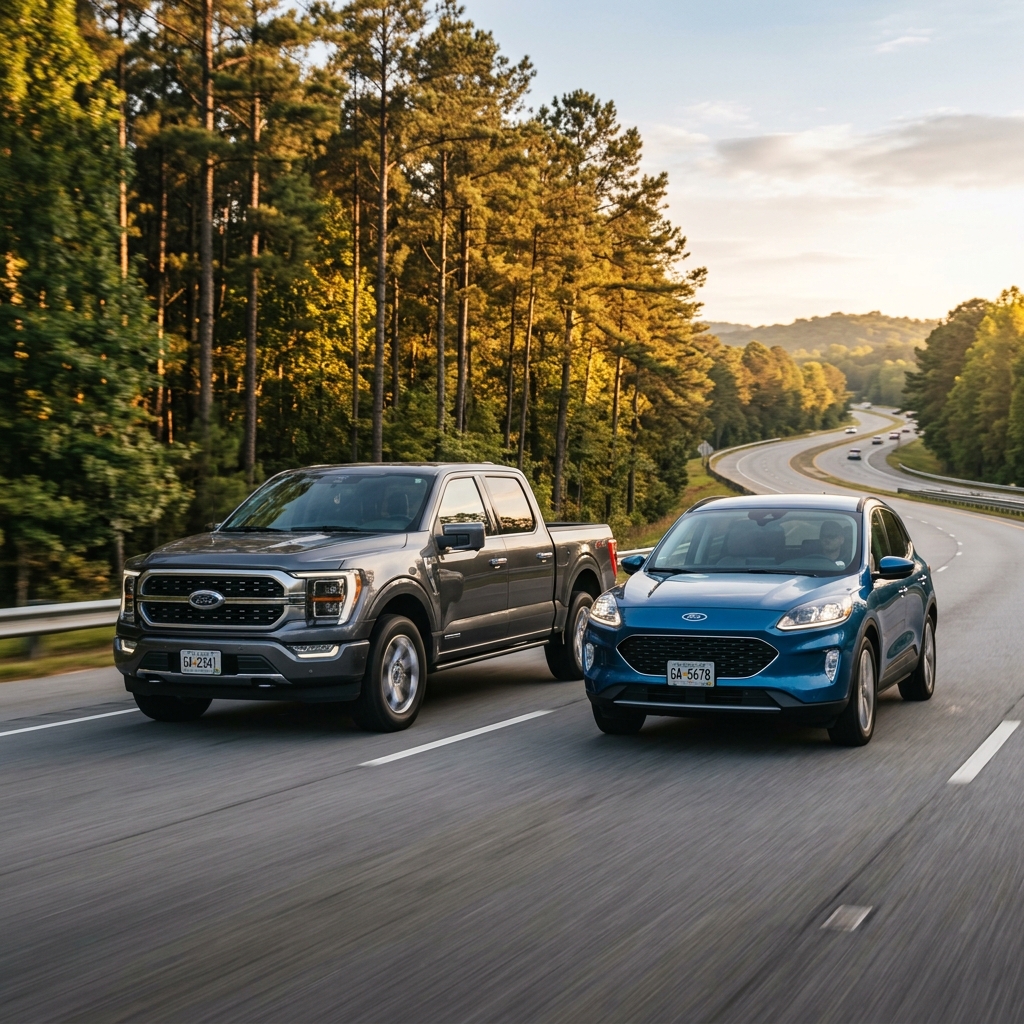
The Ford Escape is the superior choice for commuters driving the 30-mile corridor between Waynesboro and Augusta who prioritize maximum fuel efficiency, effortless urban parking, and lower daily operating costs. However, the Ford F-150 is the better option for drivers who require best-in-class towing, a heavy-duty pickup bed for work gear, or high-capacity payload ratings alongside their daily drive. For buyers evaluating upcoming 2027 releases alongside current 2025 and 2026 models, the choice rests entirely on balancing compact crossover fuel economy against full-size truck utility.
Daily highway driving across Burke County presents a varied mix of open rural stretches and congested city roads. Commuters heading toward medical centers, commercial hubs, or military facilities face distinct driving demands depending on their vehicle choice. While official 2027 release dates for both vehicles remain unannounced by Ford, current production models provide clear benchmark standards. The 2026 Ford F-150 SuperCrew and recent Ford Escape lineups both carry a 5-star overall safety rating from NHTSA, giving commuters robust structural crash protection on high-speed routes.
Selecting the right vehicle involves weighing how much capability you truly utilize during the workweek. Drivers who spend their weekends trailering boats to the Savannah River basin or hauling supplies across local farmland will find the F-150's broad capability essential. Conversely, professionals who primarily transport passengers or light cargo enjoy smoother highway cruising and fewer fuel stops in the Escape. To compare these models in person, stop by our showroom location at 330 US in Waynesboro or speak directly with our team by calling (706) 554-2114.
Table of Contents
- How Do Fuel Economy and Range Ratings Compare on Highway Commutes?
- Which Model Offers Better Daily Maneuverability and Interior Storage Flexibility?
- How Do Purchase Prices and Long-Term Operating Costs Compare for Commuters?
- Should Commuters Consider Other Ford Models Like the Maverick or Explorer?
- Common Questions About Choosing Between the Ford F-150 and Escape
- Find Your Next Commuter Vehicle at Paul Thigpen Ford
How Do Fuel Economy and Range Ratings Compare on Highway Commutes?
The Ford Escape delivers substantially higher fuel economy than the Ford F-150, achieving up to an EPA-estimated 42 mpg city / 36 mpg highway in hybrid trims compared to the F-150's peak ratings of 23 mpg combined in hybrid models. Over a standard daily 60-mile round-trip commute, the Escape Hybrid drastically reduces fuel stop frequency and annual gasoline expenses.
Commuters analyzing energy consumption will find distinct engine configurations tailored to different driving demands:
- Ford Escape 1.5L EcoBoost: Standard gas engine offering 27 mpg city / 34 mpg highway with balanced daily responsiveness.
- Ford Escape 2.5L Atkinson-Cycle Hybrid: Delivers 42 mpg city / 36 mpg highway for exceptional efficiency in heavy traffic.
- Ford Escape 2.5L Plug-In Hybrid: Reaches up to 40 MPGe combined, allowing short commuter legs to run on stored battery charge.
- Ford F-150 2.7L EcoBoost V6: Generates 325 hp and 400 lb-ft of torque while achieving 20 city / 26 highway.
- Ford F-150 3.5L PowerBoost Full Hybrid: Combines a twin-turbo V6 with an electric motor for 430 hp and 570 lb-ft of torque, delivering 23 mpg combined with 4WD.
Commuters who test-drive both models on our lot often ask about total highway range first, noticing how the F-150 PowerBoost hybrid's 31-gallon fuel tank provides up to 700 miles of total driving range per fill-up despite its full-size frame. However, in terms of gallons consumed per mile, the Escape remains the efficiency leader.
For drivers navigating dense morning traffic into downtown Augusta, the Escape's hybrid powertrain recovers energy during frequent stop-and-go decelerations. F-150 drivers benefit from smooth 10-speed automatic shifts and substantial highway passing power, though fuel stops occur more frequently over long monthly mileage totals. You can explore our pre-owned vehicle selection to see efficient commuter inventory currently available on our lot.
Which Model Offers Better Daily Maneuverability and Interior Storage Flexibility?
The Ford Escape provides easier daily maneuverability in tight spaces with its 38-foot turning diameter and compact overall length, while the Ford F-150 provides superior secure bed volume and lockable under-seat cabin storage for larger equipment. Drivers navigating tight parking structures gain a clear advantage in the Escape, whereas workers transporting bulky materials rely on the F-150's open bed capacity.
Parking and cabin storage tradeoffs break down across several practical measurements:
- Turning Diameter: The Escape turns in 38 feet curb-to-curb, compared to 48 feet for an F-150 SuperCrew, simplifying U-turns and parking maneuvers.
- Escape Interior Cargo Volume: Offers about 38 cubic feet behind the second row and up to 65 cubic feet with the 60/40 split-bench rear seat folded flat.
- F-150 Bed Cargo Volume: The standard 5.5-foot bed provides 53 cubic feet of open hauling space, complemented by flip-up rear seat cushions for enclosed cabin cargo.
- Exterior Footprint: At 181 inches long and 66 inches high, the Escape fits easily into standard garages, while the 232-inch F-150 SuperCrew requires a deep bay and taller vertical clearance.
Inside the cabin, both vehicles feature modern technology designed to keep commuters connected. The Escape offers available 13-inch touchscreens running SYNC 4 with wireless Apple CarPlay and Android Auto. High-tier F-150 models match this connectivity with 12-inch or 13-inch displays and available interior work surfaces that convert the center console into a flat desk space.
Commuters carrying groceries, luggage, or athletic gear appreciate the Escape's available Power Tailgate and weather-protected cargo area. Conversely, tradespeople and outdoor enthusiasts who transport muddy tools or wet recreation gear benefit from keeping items outside the passenger cabin in the F-150's bed. Take a moment to browse our current new Ford inventory or inspect our certified pre-owned Ford lineup to find the interior configuration that matches your daily routine.
How Do Purchase Prices and Long-Term Operating Costs Compare for Commuters?
The Ford Escape carries a significantly lower initial purchase price and lower long-term operating costs, making it the more budget-friendly option for pure daily commuting. The Ford F-150 requires a higher initial investment but offers stronger overall value retention and heavy-duty mechanical endurance for drivers who combine commuting with work or towing.
Financial considerations over a typical five-year ownership cycle include key operational variables:
- Starting Price Point: Compact crossovers like the Escape start in a lower price tier compared to full-size pickups like the F-150 STX or high-spec King Ranch trims.
- Annual Fuel Expenditure: Driving 15,000 miles per year at 39 mpg in an Escape Hybrid requires significantly fewer gallons of gas than driving the same distance at 22 mpg in a full-size truck.
- Tire and Wear Items: The Escape rides on standard 18-inch or 19-inch all-season tires, which generally cost less to replace than heavy-duty truck tires engineered for payload support.
- Dependability and Value Retention: J.D. Power rates the F-150's quality at 86 out of 100 with a Great designation, backing its long-term structural value on the pre-owned market.
Choosing between these two vehicles often comes down to evaluating whether you need a dedicated commuter vehicle or a multi-purpose work truck. Buying an Escape dedicated to highway commuting keeps daily expenses predictable. On the other hand, owning an F-150 eliminates the need to maintain a second vehicle for weekend towing, farming duties, or heavy hauling.
Our finance team works with local and national lenders to tailor loan packages to your monthly budget. You can start the buying process from home by filling out an online credit application and valuing your trade-in vehicle online to see how your current vehicle offsets your purchase.
Should Commuters Consider Other Ford Models Like the Maverick or Explorer?
Shoppers torn between the compact efficiency of the Escape and the truck utility of the F-150 should evaluate the Ford Maverick for an efficient hybrid pickup bed or the Ford Explorer for three-row family seating. The Maverick bridges the gap with up to 40 mpg combined in hybrid form, while the Explorer adds passenger capacity without truck exterior dimensions.
Comparing these alternative crossover and truck options helps clarify your priorities:
- Ford Maverick: A compact unibody pickup offering a 4,000-lb max towing capacity, a 1,500-lb payload rating, and exceptional hybrid fuel economy for light truck tasks.
- Ford Explorer: A midsize SUV providing three rows of seating for up to seven passengers, generous rear cargo volume, and standard driver-assist systems like Ford Co-Pilot360.
- Ford Escape: The optimal choice for maximum fuel economy, tight space agility, and low daily commuting overhead.
- Ford F-150: The ultimate solution for heavy towing (up to 13,500 lbs when properly equipped), off-road utility, and maximum interior cab room.
If your commute occasionally requires hauling light yard supplies or small equipment, the Maverick provides a open cargo bed on a fuel-efficient unibody platform. If your primary focus is shuttling family members alongside your work commute, the Explorer offers midsize interior comfort. Visiting our dealership allows you to compare all four vehicle platforms side-by-side.
Common Questions About Choosing Between the Ford F-150 and Escape
Q: Which Ford Escape trim provides the best highway fuel economy for long commutes?
Among Ford's lineup, the Escape Hybrid trims stand out by offering an EPA-estimated 42 mpg city and 36 mpg highway, making them top contenders for fuel-conscious commuters. For commuters with access to electric charging, the Escape Plug-In Hybrid offers up to 40 MPGe combined, allowing short daily trips to run primarily on battery power before seamlessly switching to the gasoline engine.
Q: Can the Ford F-150 fit comfortably in standard parking garages?
A standard Ford F-150 SuperCrew with a 5.5-foot bed measures approximately 232 inches long and 76 inches high, requiring careful attention in tight parking garages or compact spaces. Drivers who frequently park in multi-level city structures usually prefer the Ford Escape's 181-inch length and 66-inch height for effortless maneuverability and clearance.
Q: Does the Ford F-150 PowerBoost Hybrid require special charging equipment?
No, the Ford F-150 PowerBoost Full Hybrid is a self-charging system that requires no plug-in infrastructure or external charging stations. The powertrain automatically recharges its 1.1 kWh lithium-ion battery during normal driving through regenerative braking and engine operation while delivering 430 hp and 570 lb-ft of torque.
Q: How does rear-seat passenger room compare between the F-150 SuperCrew and the Escape?
The F-150 SuperCrew offers exceptionally spacious rear legroom at roughly 43 inches, comfortably accommodating tall adults or full-size work crews. The Ford Escape provides competitive compact crossover space with about 40 inches of rear legroom, aided by a sliding second row that adjusts fore and aft to prioritize legroom or trunk space as needed.
Q: What safety systems are standard on both the F-150 and Escape for highway driving?
Both models come standard with Ford Co-Pilot360 technology, which includes Automatic Emergency Braking, Lane-Keeping Assist, Blind Spot Information System with Cross-Traffic Alert, and Auto High-Beam Headlamps. Both vehicles have earned 5-star overall crash safety ratings from NHTSA, offering high levels of occupant protection during daily highway travel.
Find Your Next Commuter Vehicle at Paul Thigpen Ford
Selecting between the Ford F-150 and Ford Escape comes down to matching your daily driving pattern with the right balance of fuel efficiency, interior space, and towing capability. Our team at Paul Thigpen Ford of Waynesboro is ready to help you compare both models side-by-side, walk through pricing options, and arrange a test drive that reflects your exact daily drive.
We invite you to experience both vehicles firsthand by visiting our showroom location at 330 US in Waynesboro. Whether you decide on the fuel-efficient Escape or the capable F-150, our team is committed to providing straightforward advice and flexible purchase solutions. Give us a call at (706) 554-2114 today to schedule your test drive.
Keep Your Vehicle Running Strong
Keep your vehicle performing at its best with our service team: