

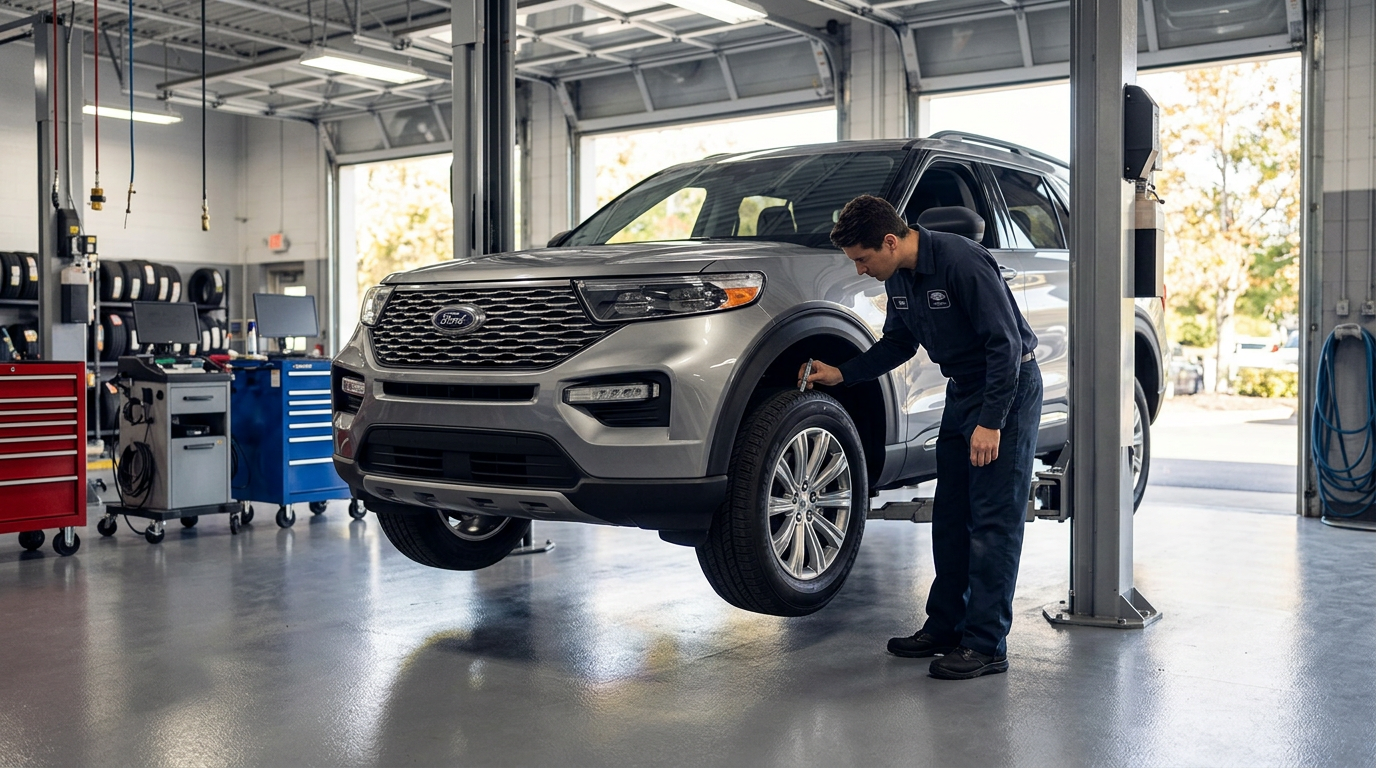
A Ford requires bi-annual seasonal maintenance centered on fluid viscosity checks, tire inspection and rotation, battery health testing, and HVAC system verification every spring and fall. Spring care focuses on clearing winter road debris, checking cabin air filters, and testing battery performance after thermal stress. Fall care prepares the vehicle for cold weather by inspecting coolant freeze protection, verifying tire tread depth, and replacing worn wiper blades.
Comprehensive bi-annual service acts as a preventative safeguard against unexpected mechanical wear. Ford recommends inspecting tire condition and pressure, engine oil level, washer fluid, and exterior lighting monthly, while scheduling a professional Multi-Point Inspection every six months or 7,500 miles. During this inspection, factory-trained technicians measure brake pad thickness, evaluate battery reserve capacity, analyze tire wear patterns, and check all underbody fluid levels.
Navigating local agricultural routes and unpaved county roads around Waynesboro exposes suspension components and underbodies to excessive dust and mud, making bi-annual underbody rinses and suspension bushing checks essential for long-term chassis durability. Whether driving a compact 2026 Ford Escape with its standard 26 city / 32 hwy rating or a three-row 2026 Ford Explorer, adhering to a seasonal care routine prevents premature component fatigue. Drivers looking to maintain their vehicle can find our Waynesboro service department easily or give our team a call at (706) 554-2114 to consult with a service advisor.
Table of Contents
- How Does the Ford Intelligent Oil-Life Monitor Adjust to Seasonal Driving?
- What Items and Specs Are Prioritized in a Ford Winter Maintenance Package?
- Should Ford F-150 Owners Switch to Dedicated Winter Tires or Retain All-Season Tires?
- How Does Summer Heat Impact Ford 12V Lead-Acid and AGM Batteries?
- How Do Ford Seasonal Maintenance Requirements Compare to Chevrolet Maintenance Schedules?
- Common Questions About Ford Seasonal Service
- What Are the Easiest DIY Ford Tasks and How Do Ford Rewards Offset Service Costs?
How Does the Ford Intelligent Oil-Life Monitor Adjust to Seasonal Driving?
The Ford Intelligent Oil-Life Monitor adjusts maintenance intervals dynamically between 3,000 and 10,000 miles by analyzing ambient operating temperatures, engine idling duration, vehicle speed, and towing loads rather than relying on a fixed odometer count. Extreme summer heat and winter short-trip driving trigger earlier service alerts to prevent thermal oil breakdown and crankcase sludge accumulation.
Under normal driving conditions, Ford recommends changing engine oil every 7,500 miles or six months, whichever comes first. However, severe seasonal weather changes how engine oil performs. Cold ambient temperatures prevent short commutes from fully warming the crankcase, allowing fuel vapors and moisture condensation to contaminate the oil. The system algorithm detects these cold-start cycles and frequent short trips, automatically shortening the interval recommendation. Conversely, prolonged highway cruising in moderate spring weather extends the calculated oil life toward the 10,000-mile upper threshold.
Turbocharged EcoBoost engines require strict adherence to Motorcraft synthetic blend or full synthetic oil standards to lubricate hot turbocharger bearings properly. When the service alert illuminates on the digital dashboard or within the Ford App, scheduling timely maintenance protects engine internal tolerances. Drivers can schedule a routine oil service online with our certified team or order Motorcraft oil filters and fluids directly for scheduled maintenance needs.
What Items and Specs Are Prioritized in a Ford Winter Maintenance Package?
A Ford winter maintenance package prioritizes battery cold-cranking capacity testing, coolant freeze-point evaluation, tire tread depth analysis, brake pad thickness checks, and wiper blade replacement. Technicians also verify that windshield washer fluid meets low-temperature non-freezing standards and inspect the heating and defrosting systems for peak airflow.
Cooling system integrity remains critical during winter months. Technicians test the concentration of Motorcraft Yellow Antifreeze/Coolant to ensure a 50/50 ratio blend, which protects against internal freezing down to sub-zero temperatures while preventing corrosion across aluminum engine blocks. Washer fluid systems are topped off with specialized solutions meeting Ford specification WSS-M19C1-C, formulated to prevent fluid reservoir freezing down to -20 degrees Fahrenheit.
Engine oil viscosity selection also plays a significant role in winter cranking performance. Models like the 2026 Ford F-150 powered by the 3.5L engine utilize Motorcraft 5W-30 or 5W-20 synthetic blend motor oil to maintain rapid lubrication across upper valve trains during cold starts. In regions experiencing sub-zero freezes, Ford approves 0W-20 or 0W-30 viscosity grades to lower engine resistance during cold cranking.
- Battery conductance test to measure remaining cold-cranking amps
- Coolant refractometer test to verify a 50/50 antifreeze protection ratio
- Brake pad measurement ensuring friction material exceeds safety minimums
- Suspension and steering boot inspection to check for cracked rubber seals
- Wiper blade evaluation and washer jet nozzle alignment
Should Ford F-150 Owners Switch to Dedicated Winter Tires or Retain All-Season Tires?
Ford F-150 owners operating in mild Southern climates benefit most from retaining high-quality all-season tires, whereas drivers frequenting sub-freezing conditions require dedicated winter tires with the 3-Peak Mountain Snowflake rating for shorter stopping distances on ice and packed snow. All-season rubber compounds harden when ambient temperatures drop below 45 degrees Fahrenheit, reducing traction even on dry pavement.
All-season tires offer versatile performance, low rolling resistance, and long tread life across moderate spring, summer, and autumn weather. However, their tread patterns lack the dense siping and soft silica compounds engineered into dedicated winter rubber. Winter tires feature aggressive directional tread grooves designed to clear slush and bite into packed snow, significantly reducing braking distances during icy morning commutes.
For drivers commuting along the Savannah River parkways in Augusta during damp winter mornings, keeping all-season tires properly inflated to door-placard specifications maintains optimal wet-road grip without needing winter rubber. Because ambient cold causes tire pressure to drop roughly 1 psi for every 10-degree Fahrenheit drop in outside temperature, monthly pressure checks prevent uneven shoulder wear. Rotating tires at every oil change interval balances tread wear across all four positions, preserving four-wheel-drive performance on truck models rated to tow up to 10,400 lbs.
How Does Summer Heat Impact Ford 12V Lead-Acid and AGM Batteries?
Summer heat damages Ford 12V lead-acid and Absorbed Glass Mat (AGM) batteries more severely than winter cold by accelerating internal plate corrosion and evaporating liquid electrolyte solution. This thermal degradation permanently lowers battery reserve capacity, causing hidden damage during hot months that manifests as unexpected startup failures when winter arrives.
High engine bay temperatures accelerate internal chemical reactions inside lead-acid batteries, causing water to evaporate from the electrolyte mix and exposing lead plates to irreversible sulfation. Modern AGM batteries, which seal electrolyte inside fiberglass mat separators, tolerate thermal stress better than traditional flooded batteries but still suffer grid degradation under sustained extreme ambient heat.
Key warning signs indicating a heat-damaged battery include:
- Noticeably slower engine cranking speed when starting
- Dimming dashboard displays or headlights while idling at intersections
- Automatic start-stop system disengaging or remaining inactive
- White or light-blue corrosion building up around terminal posts
Our technicians perform digital battery conductance tests during routine spring and autumn maintenance visits to measure actual cold-cranking capacity against original factory specifications. Catching a deteriorating battery before total cell failure prevents unexpected roadside breakdowns.
How Do Ford Seasonal Maintenance Requirements Compare to Chevrolet Maintenance Schedules?
Ford and Chevrolet seasonal maintenance schedules both utilize automated oil life monitoring to establish 7,500 to 10,000-mile service baselines, but Ford places stricter emphasis on model-specific Motorcraft fluid chemical specifications and specialized EcoBoost turbocharger care. Additionally, Ford integrated maintenance tracking and remote diagnostic alerts directly through the Ford App.
Both manufacturers have moved away from rigid mileage-only schedules in favor of algorithm-driven monitoring systems. While Chevrolet utilizes its Driver Information Center to calculate oil degradation, the Ford Intelligent Oil-Life Monitor factors in extended idling, ambient temperature swings, and towing duty cycles. Ford EcoBoost direct-injection engines require specific Motorcraft synthetic blend oils engineered to prevent low-speed pre-ignition and intake valve carbon buildup—a maintenance detail particularly critical for turbocharged engines subjected to heavy seasonal work routines.
| Maintenance Parameter | Ford Seasonal Schedule | Chevrolet Seasonal Schedule |
|---|---|---|
| Primary Oil Monitoring | Intelligent Oil-Life Monitor (3,000–10,000 miles) | Driver Information Center (7,500–10,000 miles) |
| Standard Service Interval | 7,500 miles or 6 months | 7,500 miles or 7.5 months |
| Engine Coolant Spec | Motorcraft Yellow Antifreeze/Coolant | Dex-Cool Extended Life Coolant |
| Tire Rotation Cadence | Every oil change (approx. 7,500 miles) | Every 7,500 miles |
| Connected Diagnostics | Integrated Ford App vehicle health alerts | OnStar Vehicle Diagnostics |
Common Questions About Ford Seasonal Service
Q: How often should windshield wiper blades be replaced on a Ford vehicle?
Wiper blades should be inspected during monthly car washes and replaced every six months or immediately if streaking, chattering, or rubber splitting occurs. Summer heat and winter ice degrade synthetic wiper edges quickly, compromising visibility during heavy rain.
Q: What is included in a standard Ford Multi-Point Inspection?
A Ford Multi-Point Inspection evaluates tire tread depth and wear patterns, brake pad and rotor thickness, battery charge and terminal health, fluid levels and condition, wiper blades, interior and exterior lighting, and underbody steering and suspension components.
Q: Does driving short distances in cold weather affect engine oil life?
Frequent short trips in cold weather prevent engine oil from reaching full operating temperature, allowing moisture and unburned fuel to accumulate in the crankcase. The Ford Intelligent Oil-Life Monitor detects this operating pattern and reduces the recommended oil change interval accordingly.
Q: Why is cabin air filter replacement prioritized during seasonal maintenance?
Replacing the cabin air filter every spring and fall ensures maximum HVAC heating and cooling efficiency while preventing pollen, dust, and airborne allergens from entering the passenger compartment. A clogged filter restricts airflow and causes defrost systems to work harder.
Q: How does tire pressure change during seasonal temperature transitions?
Tire pressure drops by approximately 1 psi for every 10-degree Fahrenheit decrease in ambient air temperature and rises by the same ratio when temperatures increase. Checking inflation monthly prevents uneven tread wear and maintains fuel efficiency.
What Are the Easiest DIY Ford Tasks and How Do Ford Rewards Offset Service Costs?
The easiest DIY seasonal maintenance tasks for Ford owners include checking tire pressure, inspecting windshield wiper blades, topping off washer fluid, and replacing engine and cabin air filters between professional service visits. To offset professional maintenance costs on more complex services, owners earn Ford Rewards points through vehicle purchases and dealership service visits, which apply directly as dollar-value credits toward factory-certified maintenance or genuine Motorcraft parts.
Performing basic monthly checks takes less than ten minutes and helps spot small issues before they require major repairs. Drivers can easily check tire pressure using the manufacturer placard located on the driver-side door jamb, visually inspect wiper rubber for tears, and check the engine air filter by unclipping the filter housing under the hood.
For specialized procedures like transmission fluid flushes, wheel alignment, or battery replacement on advanced models like the 2026 Ford F-150 or 2026 Ford Explorer equipped with the SelectShift® automatic transmission, relying on certified technicians ensures work meets factory standards. Earning Ford Rewards points on routine maintenance visits allows owners to accumulate credits that offset the cost of future brake service, tire replacements, or major interval packages.
Our team at Paul Thigpen Ford of Waynesboro provides transparent, reliable care to keep your truck or SUV running strong through every season. Drivers can get directions to our Waynesboro location or reach out to our service team at (706) 554-2114 to book your next seasonal multi-point inspection today.
© 2026 Paul Thigpen Ford of Waynesboro. All rights reserved.